
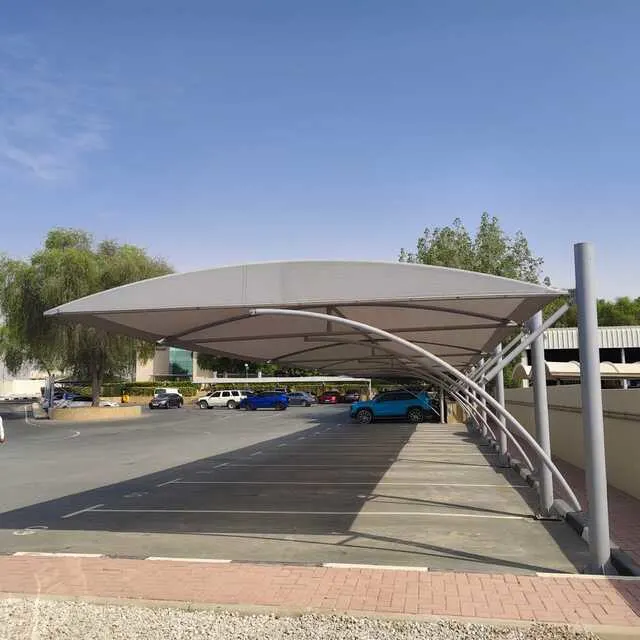
Choosing a car parking shade starts with one practical question: how much space do you actually need?
Counting vehicles is only the beginning. A useful shade layout should accommodate the cars, leave room for opening doors, allow comfortable entry and exit, and provide shade where it is needed throughout the day.
For a villa driveway, office building or commercial property in the UAE, the right car parking shade size depends on both the vehicles and the site. This guide explains what to consider before requesting a design and quotation.
Parking Bay Size and Canopy Size Are Different
A parking bay is the ground space allocated to a vehicle. The canopy is the covering above it. These dimensions do not necessarily match.
A canopy positioned directly above a parking bay may provide useful midday coverage while allowing sunlight beneath its edges earlier or later in the day. Columns, roof slopes and canopy overhangs also affect how the space works.
When reviewing a proposal, ask the supplier to show:
- Overall canopy width and length.
- Clear space between columns.
- Lowest clear height beneath the structure.
- Column positions relative to the parked vehicles.
- Canopy edges relative to walls, gates and property boundaries.
These details make it easier to judge whether the proposed structure will suit everyday use.
Planning a Car Parking Shade for One Car
For a single-car shade, begin with the actual vehicle dimensions. A compact car and a large SUV can have different access and clearance needs.
Measure the vehicle’s length, width including mirrors, and height. Then consider the space needed around it.
Can the driver open the door comfortably? Is there room to access the boot? Will passengers step onto a clear walkway? Does the gate open without interfering with the car or a support column?
For example, if an SUV is regularly parked with its rear facing a wall, the layout should allow practical access to its tailgate. Covering the vehicle’s footprint alone may leave the parking space awkward to use.
For residential projects, explore our villa and small-area car parking shades.
Planning a Car Parking Shade for Two Cars
A two-car shade should account for how both vehicles will be used at the same time.
For side-by-side parking, consider the combined vehicle widths, the gap between the cars, and access along the outer sides. A central column can influence where each vehicle parks and how easily doors open.
Before finalising the layout, check:
- Whether both cars can enter and leave independently.
- Whether passengers can open doors when both spaces are occupied.
- Whether columns interfere with reversing or turning.
- Whether one bay needs to accommodate a larger vehicle.
- Whether the entrance gate provides a practical approach to both spaces.
For tandem parking, where one car parks behind another, review the total length and the need to move one vehicle before the other can leave.
The best arrangement depends on the driveway and the household’s daily routine.
Planning Shades for Multiple Parking Spaces
For offices, warehouses and commercial properties, the design needs to work across the entire parking area.
A repeating canopy layout may look straightforward, but column positions can affect vehicle circulation, pedestrian access and the usability of individual bays.
Begin with a measured parking layout that identifies entrances, exits, driving aisles, walkways and existing obstacles. Check the proposed shade structure against this layout before confirming the number of covered spaces.
Existing drains, service covers, landscaping and underground utilities should also be considered when planning support locations.
See our office and commercial parking shade solutions for relevant project options.
Why Sun Direction Matters
Roof dimensions alone do not determine effective shade coverage. The position of the sun changes throughout the day and across the year.
A parking space mainly used during office hours has a different usage pattern from a villa driveway where vehicles remain parked into the late afternoon.
Tell your supplier when the parking area is used most. Ask them to consider the site orientation and expected shade coverage at those times.
Taking photographs of the parking area in the morning, around midday and later in the afternoon can help explain your concerns. A site-specific assessment can then inform the canopy position, height and overhang.
Choosing the Right Clear Height
Clear height means the usable space beneath the lowest part of the structure.
This may be limited by a beam, a sloping canopy edge or another structural component. The highest point of the roof does not tell you whether a vehicle can pass comfortably beneath it.
Consider the tallest vehicle expected to use the space, including roof racks or other accessories. Where relevant, also check clearance for an open tailgate.
A taller canopy is not automatically the better choice. Height influences the overall design and the way sunlight reaches beneath the roof. Ask the supplier to balance vehicle clearance with useful shade coverage.
How Support Columns Affect Usable Space
Two parking shades with the same overall roof dimensions can offer different amounts of usable parking space.
A column beside a driver’s door can make entry difficult. A support near a gate can restrict turning. A base positioned along a walkway can interrupt pedestrian access.
Review the column layout with vehicles shown in their intended parking positions. For tight spaces, ask whether an alternative support arrangement could improve access, subject to suitable structural design.
Our custom shade design service can help you discuss a layout suited to your property.
Information to Prepare Before Requesting a Quotation
A clear project brief helps a supplier propose an appropriate solution. Prepare the following:
- Site location and photographs.
- Available parking width and length.
- Number and types of vehicles.
- Gate position and opening direction.
- Nearby walls, doors, windows and walkways.
- Preferred parking arrangement.
- Any known underground services or installation restrictions.
- Whether rain protection is also required.
Share your priorities as well. These might include easier SUV access, fewer obstructions near doors, improved afternoon coverage or space for a future second vehicle.
Frequently Asked Questions
Is there one standard car parking shade size?
There is no single size suitable for every property. The layout should reflect the vehicles, access requirements, available space and applicable project requirements. A measured site assessment helps establish suitable dimensions.
Can one canopy cover two cars?
Yes, a canopy can be designed to cover two vehicles. Its dimensions and support arrangement should allow both vehicles to park and their occupants to enter and exit comfortably.
Should the canopy extend beyond the parking bay?
An overhang may improve coverage, but its suitability depends on sun direction, canopy height, boundaries and structural design. The supplier should explain the proposed coverage for your site.
Can I extend a parking shade later?
An extension may be possible, but it should not be assumed. If you expect to add parking spaces, discuss this during the initial design so future requirements can be considered.
Discuss Your Car Parking Shade Layout with BAB TENTS
A well-planned parking shade should fit your vehicles and make the space convenient to use.
BAB TENTS supplies and installs car parking shades for residential and commercial properties in the UAE. Share your site photographs, available dimensions and vehicle requirements to discuss a suitable layout and quotation.
Email: sales@babtents.ae
Explore our car parking shade solutions.