
Choosing the Right Workforce Accommodation Starts with Understanding Your Project
Providing safe, comfortable, and practical accommodation for workers is an essential part of managing any construction, industrial, or infrastructure project. One of the biggest decisions businesses face is whether to invest in temporary labour tents or build permanent accommodation.
Both options have their advantages, but the right choice depends on several factors, including project duration, workforce size, budget, site conditions, and future operational plans.While temporary labour tents offer flexibility and faster deployment, permanent accommodation provides long-term stability for ongoing operations. Understanding the strengths and limitations of each option can help businesses make informed decisions that support both operational efficiency and worker well-being.
In this guide, we’ll compare temporary labour tents and permanent accommodation to help you determine which solution best suits your project.
Why Workforce Accommodation Matters
Worker accommodation is more than just providing a place to rest. A well-planned accommodation solution contributes to:
- Improved worker comfort
- Higher productivity
- Better health and safety standards
- Efficient site management
- Compliance with project requirements
- Enhanced workforce satisfaction
Selecting the right accommodation type can reduce operational challenges while creating a more organized and productive work environment.
What Are Temporary Labour Tents?
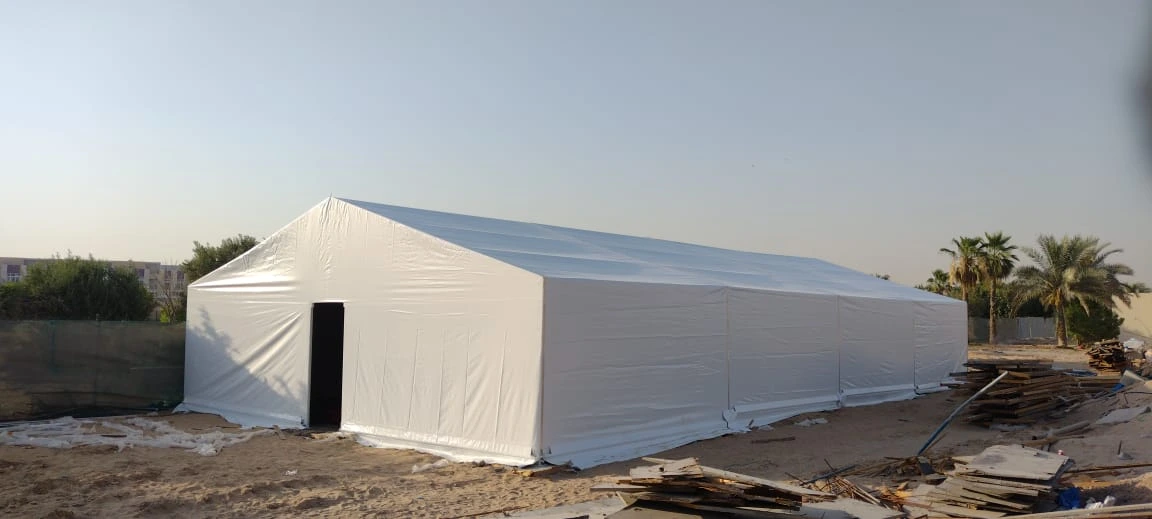
Temporary labour tents are prefabricated fabric or steel-framed structures designed to provide comfortable workforce accommodation for short-term or medium-term projects.They are commonly used on:
- Construction sites
- Infrastructure projects
- Oil and gas facilities
- Industrial developments
- Mining operations
- Remote project locations
These structures can be installed quickly and customized with features such as ventilation systems, insulation, lighting, partitions, flooring, and sanitation facilities, depending on project requirements.
Advantages of Temporary Labour Tents
Fast Installation
One of the biggest advantages of temporary labour tents is their quick setup. Unlike permanent buildings, which may take several months to complete, labour tents can often be installed within a much shorter timeframe, allowing projects to begin without unnecessary delays.
Cost-Effective Solution
For projects with limited timelines, temporary structures generally require a lower initial investment than constructing permanent accommodation.Businesses also avoid many of the long-term construction costs associated with traditional buildings.
Flexible and Relocatable
Project locations often change, especially in construction and infrastructure industries.Temporary labour tents can be dismantled, transported, and reinstalled at another site, making them a practical solution for companies managing multiple projects.
Scalable for Growing Workforces
As workforce requirements change, temporary accommodation can easily be expanded by adding additional units without major construction work.This flexibility helps businesses adapt to changing project demands.
What Is Permanent Accommodation?
Permanent accommodation consists of fixed buildings designed for long-term workforce housing.These facilities are commonly constructed using traditional building materials such as concrete, steel, and masonry, providing a stable solution for organizations with continuous operational needs.Permanent accommodation is often found in:
- Manufacturing facilities
- Industrial plants
- Mining camps
- Government housing projects
- Large institutional developments
Although these structures require more time and investment to build, they offer long-term durability and stability.
Advantages of Permanent Accommodation
Long-Term Investment
For businesses operating at a fixed location over many years, permanent accommodation can provide lasting value.Its durability makes it suitable for organizations with ongoing workforce requirements.
Enhanced Comfort
Permanent buildings generally offer greater design flexibility, allowing businesses to incorporate:
- Private rooms
- Dining facilities
- Recreation areas
- Medical rooms
- Administrative offices
- Larger communal spaces
These additional amenities can improve overall living conditions for workers.
Strong Structural Durability
Permanent accommodation is designed for continuous use over many years and typically requires fewer relocations or structural modifications.With regular maintenance, these facilities can support long-term operational requirements.
Suitable for Established Operations
Organizations with permanent facilities and a stable workforce often benefit from investing in dedicated accommodation that becomes part of their long-term infrastructure.
Temporary Labour Tents vs Permanent Accommodation: A Quick Comparison
| Feature | Temporary Labour Tents | Permanent Accommodation |
| Installation Time | Fast | Longer construction period |
| Initial Investment | Lower | Higher |
| Relocation | Easy to relocate | Fixed location |
| Scalability | Easy to expand | Requires additional construction |
| Best For | Short- and medium-term projects | Long-term operations |
| Flexibility | High | Limited |
| Maintenance | Periodic fabric and structural maintenance | Regular building maintenance |
| Customization | Highly customizable | Fully customizable during construction |
This comparison highlights that neither option is universally better. The ideal choice depends on your project’s duration, operational goals, and future plans.
Factors to Consider Before Making Your Decision
Before selecting a workforce accommodation solution, evaluate the following key factors.
Project Duration
The expected length of your project is one of the most important considerations.If your project will run for several months or a few years, temporary labour tents often provide the flexibility and cost efficiency needed. However, for operations expected to continue indefinitely at the same location, permanent accommodation may offer better long-term value.
Workforce Size
The number of workers you need to accommodate directly affects the type of solution required.Temporary labour tents are ideal for projects where workforce numbers may increase or decrease over time, while permanent accommodation is generally better suited to organizations with a stable workforce.
Budget
Every project has financial constraints.Temporary labour tents typically require a lower upfront investment, making them suitable for businesses looking to optimize capital expenditure.Permanent accommodation involves higher construction costs but may become more economical over many years of continuous use.
Site Conditions
Project locations vary significantly.Remote construction sites, desert environments, and temporary industrial facilities often benefit from labour tents because they can be installed quickly with minimal site preparation.Permanent buildings generally require more extensive planning, approvals, and infrastructure before construction begins.
Future Expansion Plans
Think beyond your current project requirements.If additional workers may be required in the future, modular labour tents provide an easy way to expand accommodation without major disruption.Permanent facilities usually require new construction when additional capacity is needed.
Which Solution Is Best for Different Projects?
Choosing the right accommodation often depends on the nature of the project itself.
Temporary Labour Tents Are Ideal For
- Construction projects
- Infrastructure developments
- Oil and gas sites
- Mining operations
- Emergency response camps
- Remote industrial projects
- Seasonal workforce accommodation
Permanent Accommodation Is Better For
- Manufacturing plants
- Industrial campuses
- Government facilities
- Long-term mining operations
- Educational institutions
- Large corporate facilities
Matching the accommodation type to your operational requirements helps maximize efficiency while controlling long-term costs.
Common Misconceptions
Many businesses assume one solution is always better than the other, but that isn’t necessarily true.
“Temporary labour tents aren’t durable.”
Modern labour tents are engineered using high-quality fabrics and robust steel frameworks, making them suitable for demanding environments when properly maintained.
“Permanent accommodation is always the better investment.”
Not every project requires permanent infrastructure. For temporary or changing worksites, investing in permanent buildings may result in unnecessary costs and underutilized facilities.
“Temporary accommodation offers limited comfort.”
Today’s labour tents can be equipped with insulation, ventilation, lighting, partitions, flooring, sanitation facilities, and other amenities to create safe and comfortable living environments for workers.
Final Thoughts
Both temporary labour tents and permanent accommodation play an important role in workforce housing, but the right choice depends on your project’s unique requirements.Temporary labour tents provide flexibility, faster deployment, and cost-effective accommodation for changing project environments, while permanent accommodation offers long-term stability for organizations operating from fixed locations.
By evaluating factors such as project duration, workforce size, budget, site conditions, and future expansion, businesses can make informed decisions that balance operational efficiency with worker comfort.Choosing the right solution from the beginning not only supports project success but also contributes to a safer, more productive working environment.
Find the Right Workforce Accommodation for Your Project
Every project has unique accommodation requirements, and selecting the right solution starts with understanding your operational needs.Whether you’re planning a short-term construction project or developing long-term workforce facilities, taking the time to evaluate your options can help improve efficiency, optimize costs, and create a better living environment for your team.
At BAB Tents, we work with businesses across the UAE to develop workforce accommodation solutions that align with their project goals, site conditions, and operational requirements. Our experienced team can help you explore practical options and recommend a solution that fits your workforce today while supporting your future plans.
Speak with our specialists to discuss your project requirements and discover the most suitable accommodation solution for your workforce.
Frequently Asked Questions
1. What is the main difference between temporary labour tents and permanent accommodation?
Temporary labour tents are designed for flexibility, quick installation, and relocation, while permanent accommodation is built for long-term use at fixed locations.
2. Are temporary labour tents suitable for the UAE climate?
Yes. High-quality labour tents are designed to withstand challenging weather conditions and can be equipped with insulation, ventilation, and other features to improve comfort.
3. Which option is more cost-effective?
Temporary labour tents generally require a lower initial investment, making them suitable for short- and medium-term projects. Permanent accommodation may provide better long-term value for fixed operations.
4. Can temporary labour tents be expanded as workforce requirements grow?
Yes. One of the key advantages of temporary labour tents is their modular design, allowing additional units to be added as project requirements change.
5. How do I decide which accommodation solution is right for my project?
Consider factors such as project duration, workforce size, budget, site conditions, and future expansion plans. Consulting with experienced professionals can help you identify the most practical solution.